New look and agentic loop everywhere

These last weeks were busy on two fronts: we gave CWCloud a new look, from the website to the console, and we generalized the same agentic loop to CWCloud itself, CWClock and qwctl, as well as to Uprodit and StrongFish, two platforms we host and for which we work as agentic AI consultants and developers. And since all of this can be triggered from our low-code serverless functions, this blogpost wraps it all up.
A new look
The website
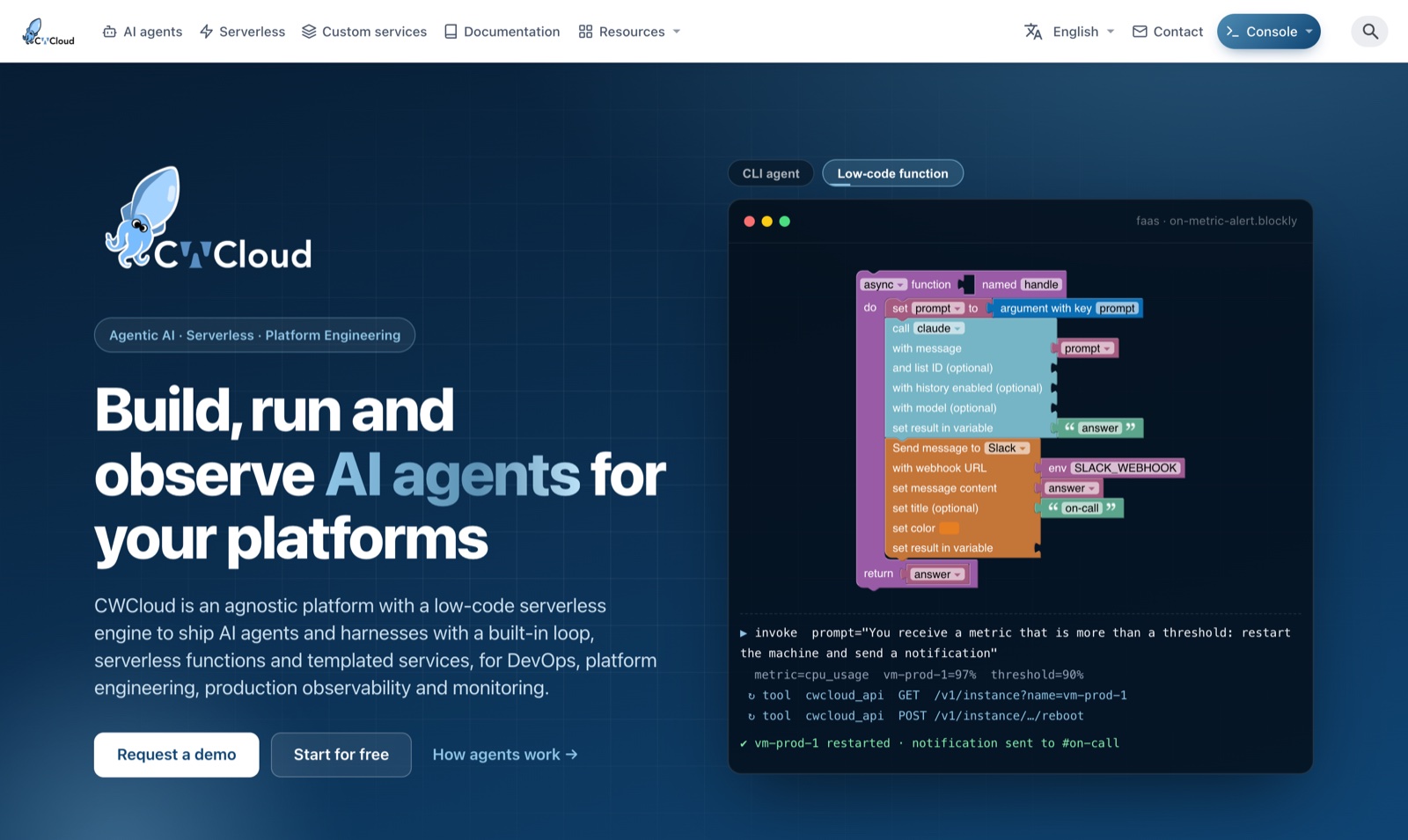
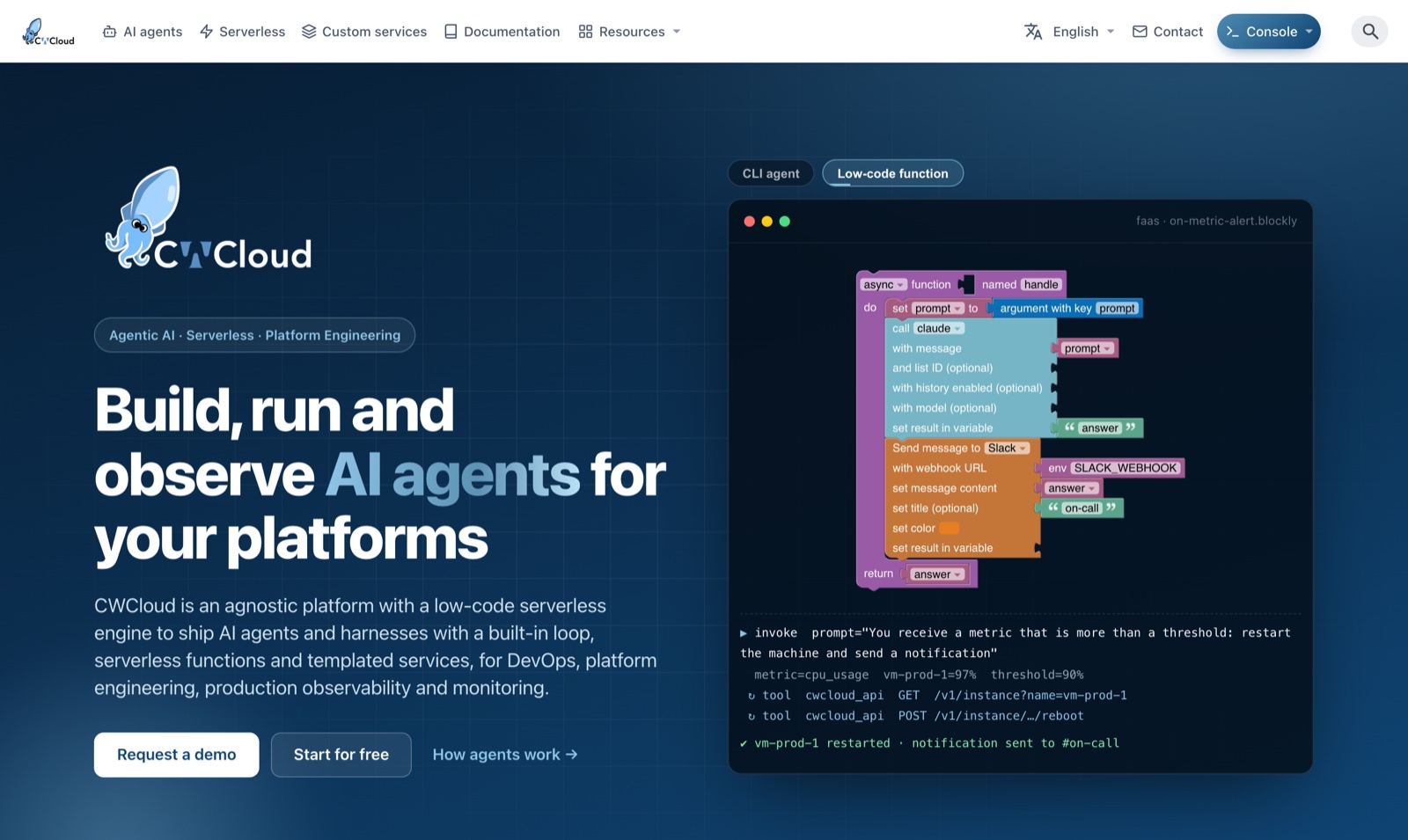
We modernized the website and refocused it on the agentic AI features: running agents from the cwc CLI, from a chat or from low-code serverless functions.
The console
The console got a new look as well, built around the AI: the CWAI chat where the assistant works on your resources, and an AI management menu where the administrators handle the AI usage, the AI subscriptions and the external adapters.
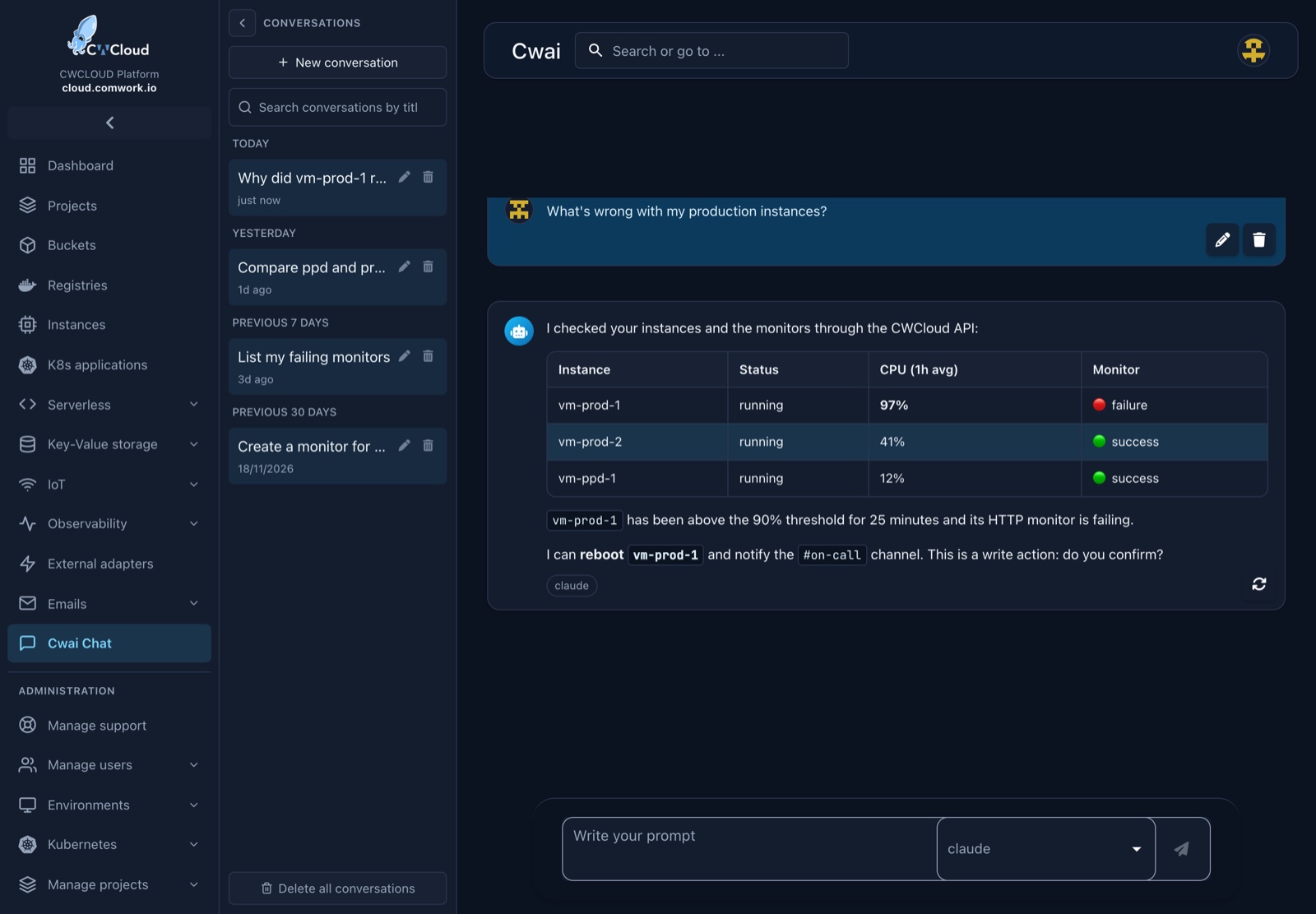
The screenshots above use demo data.
One agentic loop, five platforms
An agentic loop is simple to explain: instead of answering with text only, the model is given tools, it decides which ones to call, reads their results, calls other tools if it needs to, and only then answers. We implemented the same loop everywhere with the same rules:
- the loop is bounded (a few rounds at most), so a confused model can't spin forever;
- the main tool is the product's own API, called with the token of the connected user, so the agent can never do more than the user could do himself;
- every write (creating, updating, deleting something) needs an explicit confirmation from the user: the agent first explains what it is about to do and waits;
- the models are configured as AI subscriptions (OpenAI, Anthropic, Gemini, Mistral, any OpenAI-compatible model... or CWCloud itself), so you bring your own keys and switch providers without changing anything else.
CWCloud
The hard-coded model adapters are gone: administrators now manage global AI subscriptions that every user with the CWAI feature can use, and users can share their own external adapters with other users or make them public. Subscriptions and adapters can be exported and imported as JSON from one instance to another, and the tokens billing is configured with environment variables.
The CWAI assistant now uses the CWCloud API as a tool: ask it to list your instances, check a monitor or explain your consumption, and it calls the API on your behalf. It can also reach other CWCloud instances you registered as tenants (your staging and production platforms, a customer's own instance, etc.), generate downloadable files, and when the AI provider fails, its error is shown as-is so you know what happened.
CWClock
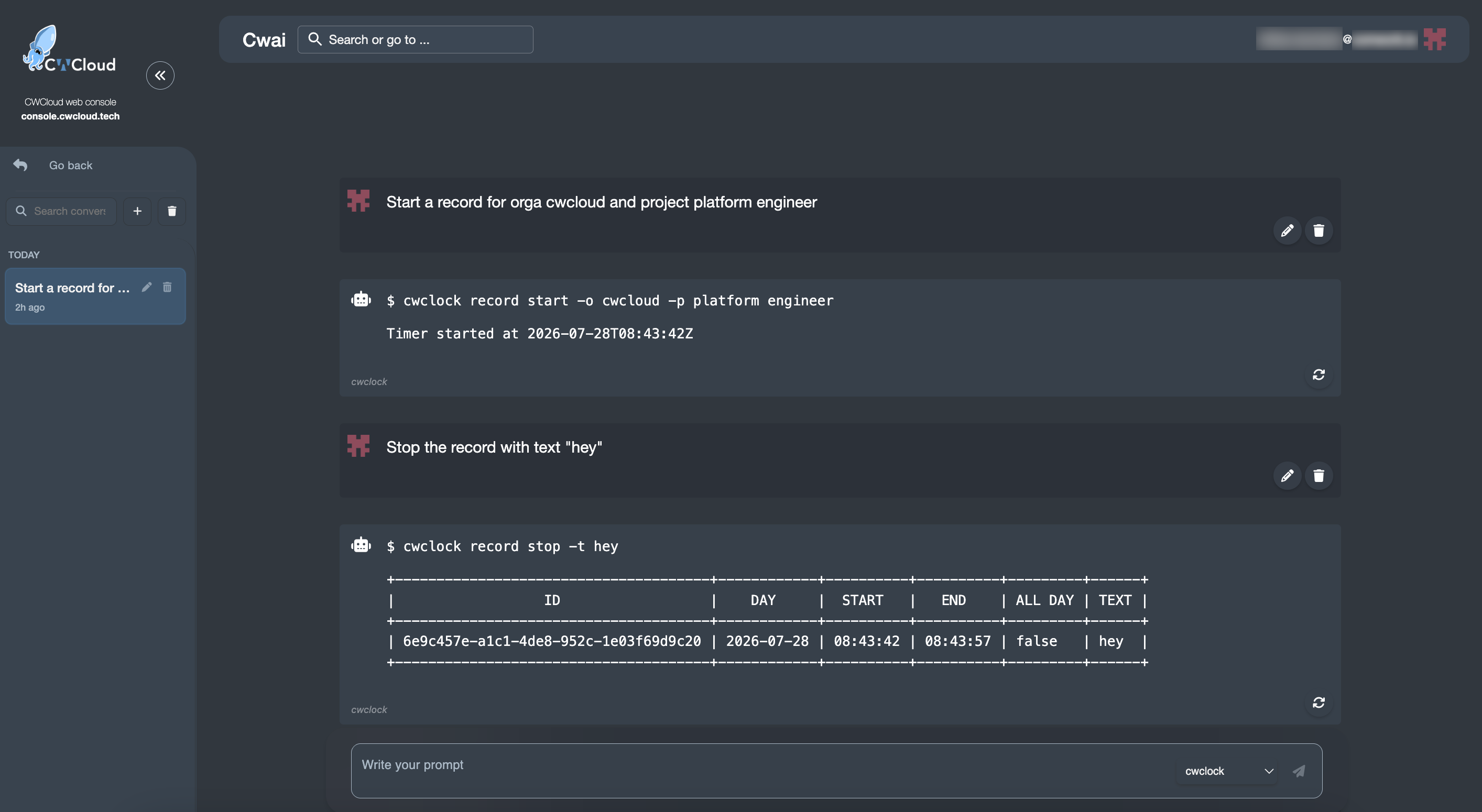
CWClock, our Open Source time tracking application, got the same assistant: AI subscriptions, the CWClock API as a tool, and a confirmation before writing anything. You can for instance ask it to fill your working days for the month: it shows you the preview (public holidays excluded) and only creates the time entries once you've confirmed. The CLI also works as an agent with an embedded MCP server.
qwctl
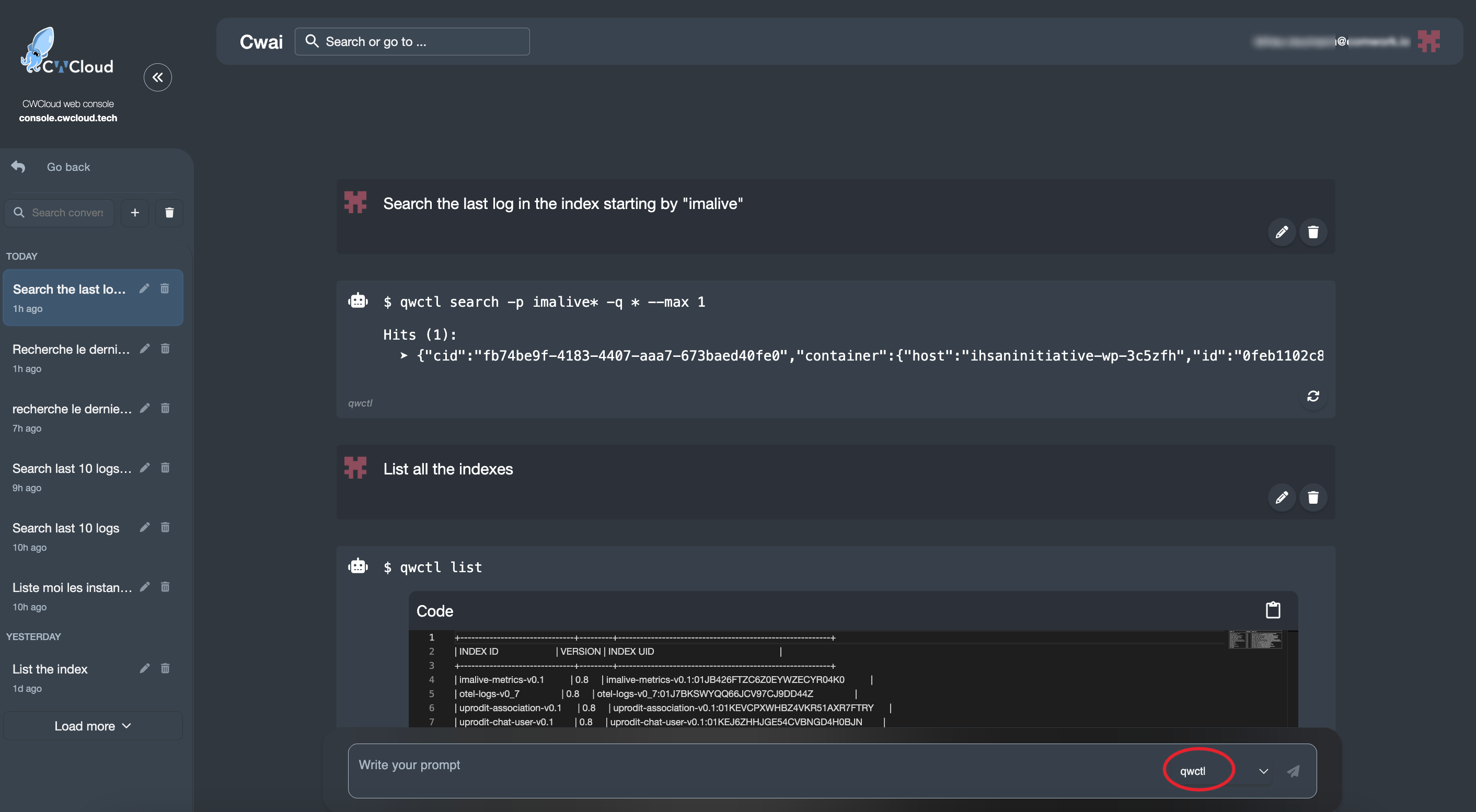
qwctl, the Quickwit CLI we contribute to, embeds an MCP server and runs as a web agent compliant with the CWAI external adapter interface: plug it into CWCloud and you can investigate your logs and traces in plain language, from the chat, a GitLab webhook or a serverless function.
Uprodit
Uprodit is a social network dedicated to Tunisian freelancers, online for more than twelve years. We host it and, as agentic AI consultants and developers, we built its AI features. Freelancers publish their profile, skills and references, companies search for them (with a Quickwit search engine) and get in touch, and the platform also hosts cooperatives of freelancers. Its old Java backend has been rewritten in Go.
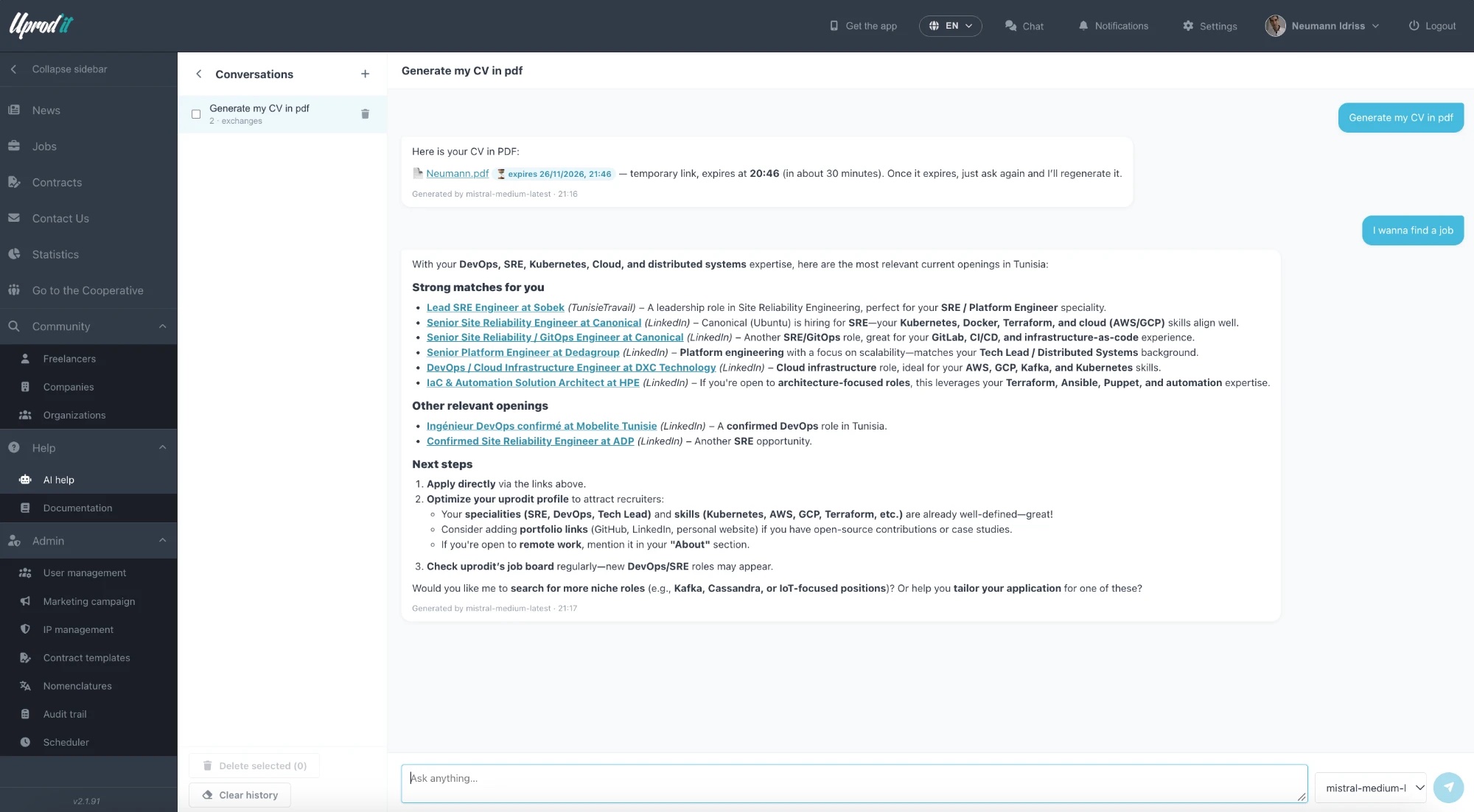
Uprodit got its AI assistant too, in both its web applications: it reads the Uprodit API with the connected user's rights to answer questions about profiles, statistics or contacts, generates a freelancer's CV as a downloadable PDF, finds the job offers matching their skills, and administrators even have one write tool (purging spam accounts) which, of course, shows a preview and waits for a confirmation.
StrongFish
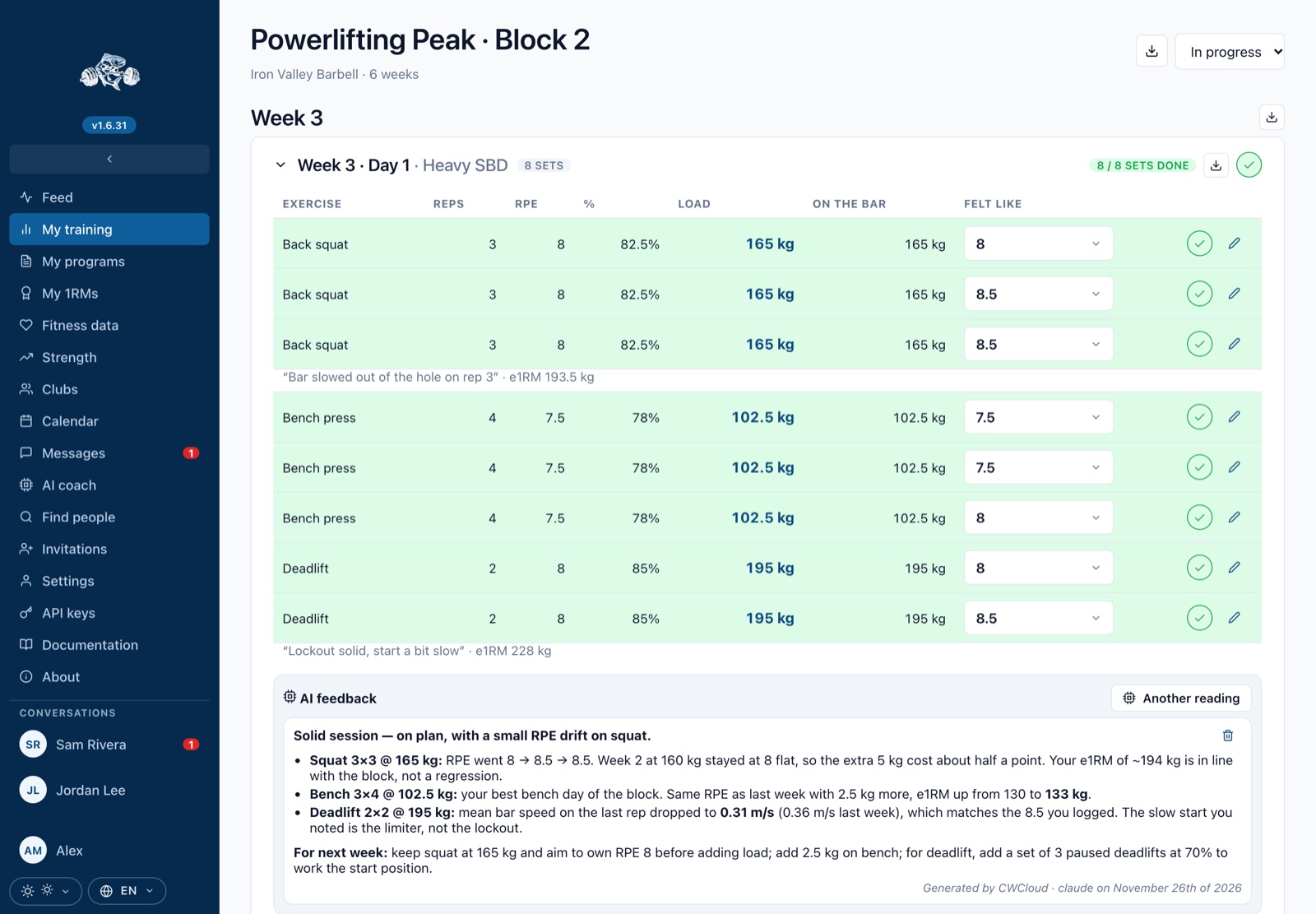
StrongFish is a powerlifting social network and app: a training feed and clubs, RPE-based programs whose loads follow each athlete's own maxes, velocity-based training with bar sensors, and the fitness data of the athletes' watches, scales and food diaries (Garmin, Withings, Google Health, etc.). Here too, we host it and build its agentic features.
Its AI coach reads a finished training session against the previous ones (RPE drift, bar speed, what to change next week) and reads ninety days of fitness data (sleep, heart rate, steps, body composition, nutrition) to give the athlete and their coach actionable feedback. Each athlete or coach brings their own AI subscription, and CWCloud is one of the providers: one CWCloud key gives access to every model the account has been granted, with the billing and the usage tracked on the CWCloud side.
Each platform is also a model for the others
Two bridges make these platforms work together:
- CWCloud as a provider: CWClock, Uprodit, StrongFish,
qwctland our CLIs can use a CWCloud subscription as their model, so you only manage your provider keys in one place; - each platform as an external adapter: CWClock, Uprodit and StrongFish expose their own AI subscriptions to CWCloud through the external adapter interface, like
qwctldoes with its web agent.
No more legacy code in production
Behind these features, there's also a lot of groundwork: we rewrote almost everything in Go or in Python with FastAPI across the different products (APIs, CLIs, agents, MCP servers). Today, no legacy code runs in production anymore, neither for our customers nor for ourselves, which is also what makes it possible to ship these agentic features this quickly everywhere.
Serverless: triggering agents without a single line of code
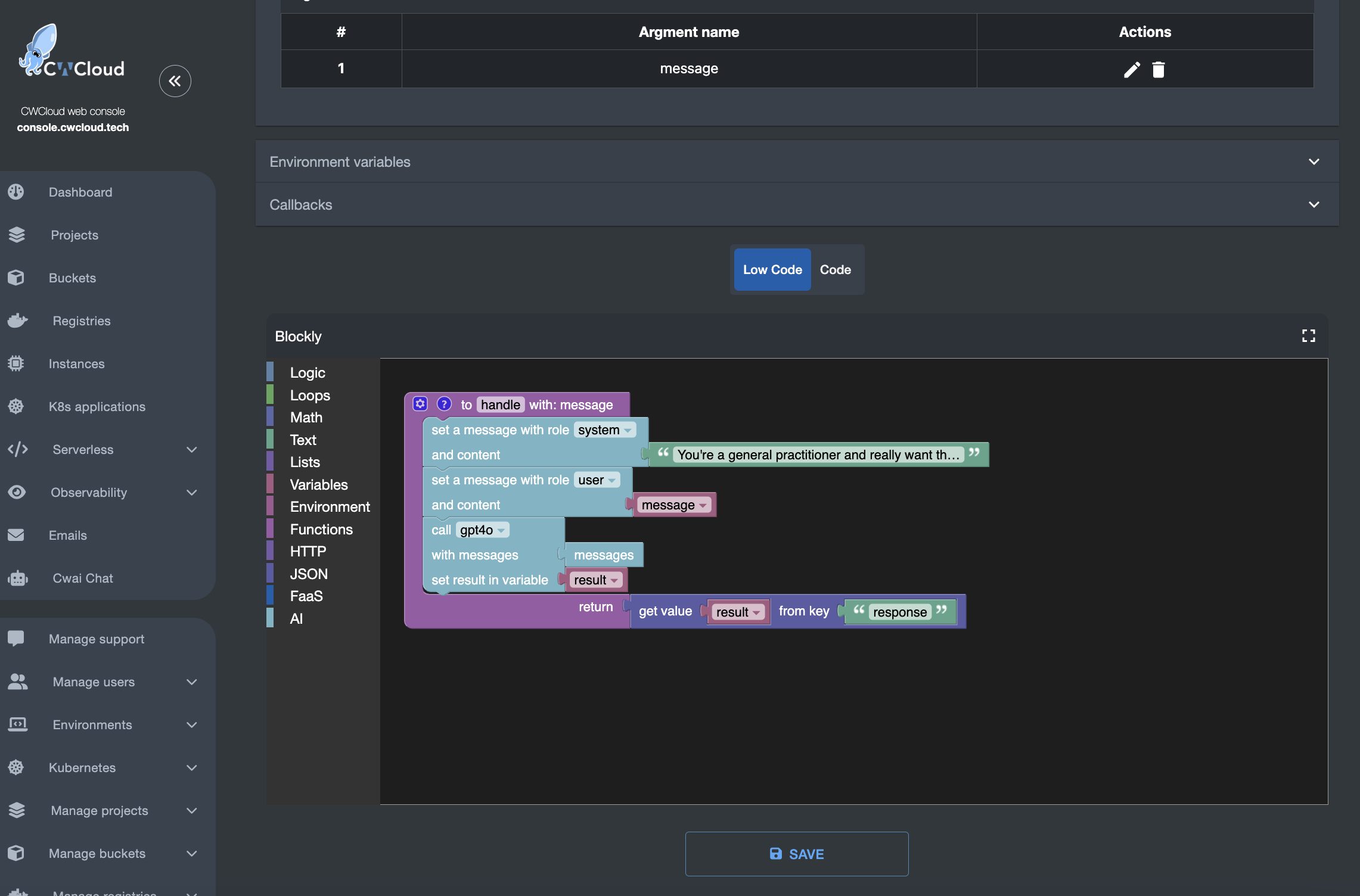
This is where it all comes together. CWCloud's low-code serverless engine lets you build functions with Blockly blocks, and one of these blocks calls an AI adapter: any subscription, or any external adapter (so CWClock, Uprodit, StrongFish or qwctl as well).
Take the scenario of the homepage: a monitor detects that a metric crossed a threshold and invokes a function with a prompt as its argument, "you receive a metric that is more than a threshold: restart the machine and send a notification". The function passes the prompt to the agent, which finds the instance and restarts it through the CWCloud API, and the function then posts the agent's answer to Slack:
The same function could be triggered by a cron, a webhook or an IoT object, and call CWClock to fill time sheets or qwctl to analyze the logs of the failing service. You can read more about it in the CWAI and agents documentation.
Feel free to contact us if you want a demo!